Day 2 and this CKM has already put my mind at work.
What I’ll write down below is how I interpret the data, knowing my own history, and using all the scientific literature I’ve read so far. But I have to admit, being sick is a variable I don’t know much of how it influences metabolism.
Before getting into the observations, I’d like to share some principles to keep in mind when elements are measured in our body. It is a general principle that matters a lot and is abundantly present in many forms.
Buffers
Most of what is measured in our fluids can be seen as a buffer. What you’ll see here is fairly straightforward but it is good to have in mind later on to understand measurements and changes in measurements. In this particular case of ketones.
So…
- The influx and outflux determine the level of the buffer.
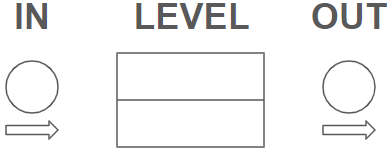
- If you increase the influx without compensating on the outflux then the level rises. We are faced with a first problem. How do we know if the level is rising if we do only 1 measurement? How about 2 measurements? The measurements have to follow quickly enough to know if there is movement or stability.

- To stop it from rising, either the influx has to revert to its previous state or the outflux has to pick up. Here we are faced with another problem for observations. When you do a measurement of how much is in the buffer, how do you know if the production and consumption is high or low? A steady level at any level can be reached with any flux where in and out are equal after the rise or fall of the level.

- In our bodies there is another factor to take into account and that is the speed of the blood flow. This can differ regionally such as for specific brain regions in response to certain foods or head traumas or when exercising the blood volume may be diverted more to muscle. The arrow here represents the change in blood flow.

- And a final principle is that the buffer generally needs to be high enough relative to the outflux. If this is not the case, then any disruption or hiccup in the influx will immediately affect the outflux. So the bigger the consumption, the higher you want to have the buffer to be more tolerant to disruptions in supply.
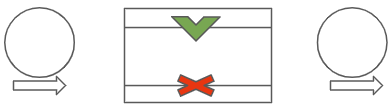
That doesn’t mean that a high buffer is therefor always a sign of high consumption! You can get this as wel with a temporary rise in influx without change in outflux, as we’ve seen, or a temporary reduction in outflux.
So when you measure higher or lower values, you have to have more evidence before you make any conclusions about its effect! Observing the dynamics and knowing the processes that influence it are key together for a good understanding.
With these principles in mind we can now look at my early ketone readings where I try to understand what is going on.
First day measurements
As a reminder, read my introduction as these measurements are relative to my body.
As mentioned in the title, I’m actually sick when I applied the SiBio sensor. This has brought some interesting results.
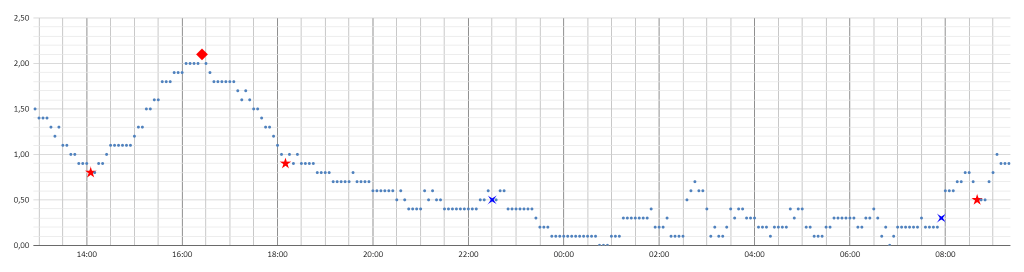
A sedentary day with the following events:
- 14:00 lunch: 6 eggs, shredded cheese, +/- 50gr butter
- 16:25 felt slightly nauseous
- 18:10 dinner: steak (+/-250gr) with butter from the pan and a bit of tomatoes
- 22:30 went to bed
- 08:00 got up
- 08:40 had breakfast
Observation 1
Why the nauseous feeling? I suspect ketoacidosis and here’s why. I’ve noticed in the past that, despite being on keto, my glucose level rises when being sick. This is probably because our immune system cells need to proliferate to target the infection. The glucose is not just for energy, it serves as a carbon source to construct the cells.
But how can the glucose be protected? Many cells in our body all would take in the extra glucose. For example the uptake in muscle is sensitive to the concentration.
The answer may be in insulin resistance. An infection can increase cortisol in response to the cytokines. This will lead to insulin resistance.
Viral infections can induce several physiological changes in the human endocrine system, resulting in cytokine mediated activation of hypothalamo-pituitary-adrenal axis to increase cortisol production, thus modulating the immune response.
“Infections in Endocrinology: Viruses” https://www.ncbi.nlm.nih.gov/books/NBK568565/
Cortisol was higher in patients infected with IBV (Influenza B virus) and correlated positively with CCL20 (P < 0.05).
“Cortisol and perceived stress are associated with cytokines levels in patients infected with influenza B virus” https://www.sciencedirect.com/science/article/abs/pii/S1043466620304166
Assuming that is the case for me, it becomes easy to understand why there was such a continuous rise in ketones. Likely, under such insulin resistance and with a higher level of gluconeogenesis, it probably also raised my glucose level, together caused the trend towards ketoacidosis. Unfortunately I didn’t measure glucose levels but it is a safe bet.
The drop is as sharp as the rise. To reverse such a trend, I suspect my body increased insulin secretion acutely.
Observation 2
I was surprised to see that my ketones were low during sleep. When I pick up my regular routine again, I’m curious what the result will be with resistance exercise in the evening because now I have to consider that the result is influenced by the infection.
Why a decrease though? There’s a decrease in metabolism during sleep throughout the body but I don’t think this is the case for the brain.
It is believed that during normal sleep the metabolic rate reduces by around 15% and reaches a minimum in the morning in a standard circadian pattern [8, 9].
“Sleep and Metabolism: An Overview” https://www.hindawi.com/journals/ije/2010/270832/
The brain needs that energy to process impressions, to reason about them and give them a place. At least I suspect that from my experimentation with psilocybine.
If the brain would maintain its activity during sleep then it means that the energy consumption by the rest of the body is more closely to 20%.
| energy | kcal | sleep kcal | ||
| brain | 20% | 500 | 500 | |
| rest | 80% | 2000 | 1625 | 81,25% |
| total | 100% | 2500 | 2125 | 85,00% |
However, I can’t find a firm conclusion in the literature. Slow wave sleep is said to reduce brain metabolism while during REM sleep it increases. And of course none of these studies are done in people on a ketogenic diet.
In addition we need to keep in mind a potential difference in beta-hydroxybutyrate concentration between blood and interstitial fluid. Too many unknowns to really understand what is going on.
A final observation to point out is that between the moment I got out of bed and had breakfast, ketones went up again. Heart rate picked up and perhaps this explains morning cortisol. As our body awakes, it starts to consume more energy. To prepare for this event there’s a bit of insulin resistance needed to prevent a sudden drop in energy availability as metabolism restores again.
Lessons learned
Really listen to your body. If you are sick and don’t feel hungry then simply don’t eat. Certainly not the type of meal I had for lunch.
Second day
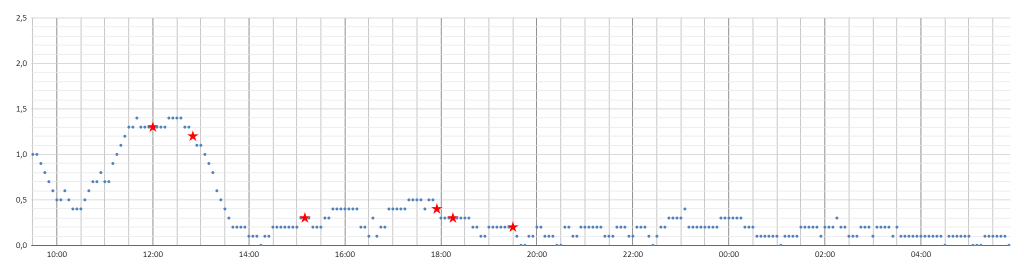
Events marked:
- 12:00: 2 coffees, slices of cheese and salami and another coffee
- 12:50: cheesecake
- 15:10: 2 slices of gouda cheese
- 17:55: veggie soup with coconut oil
- 18:15: meat balls with tomato sauce and cabbage
- 19:30: glass of milk
Interestingly, after my breakfast at 08:40 there’s a rise followed by a dip and then rise again. It was the same breakfast as before but less of it. I could understand the rise but not the dip unless this is part of insulinogenic regulation.
I was attending a funeral followed by the typical meal afterwards and decided to have a go at the cheese cake to see how it would evolve.
As expected a drop but by around 14:00 I did notice the very mildly symptoms of hypoglycemia. Obviously being sick is problematic for energy regulation so again, if you don’t feel hungry then don’t eat!
The rest of the day is nothing special but as you can see the ketones remain low and also during sleep the ketones are lower than the previous night.
I’m excited about this CKM! It raises a lot of interesting ideas and points to investigate and learn about.
————————————- T H E – E N D ————————————-
 Designed By Nature
Leave a comment